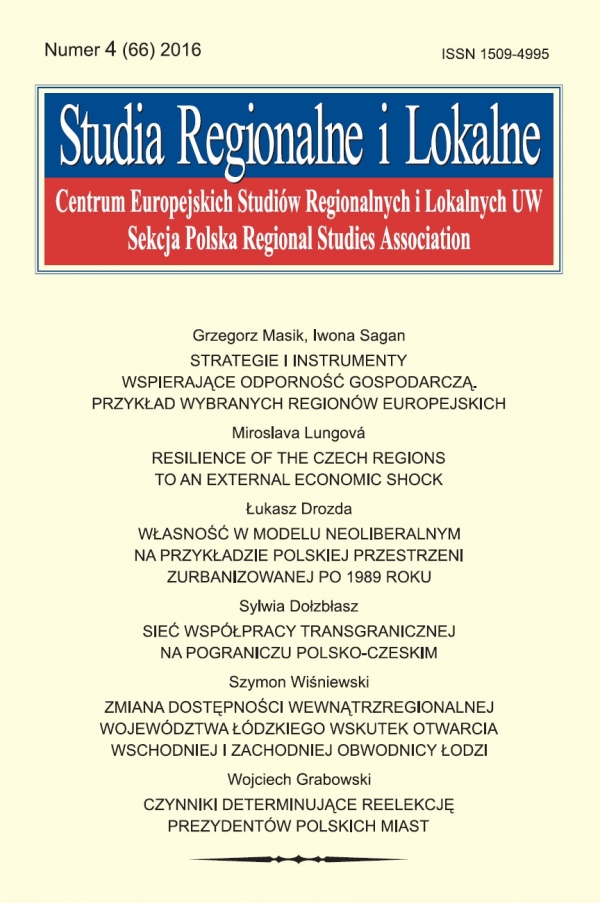
Grzegorz Masik, Iwona Sagan
Strategie i instrumenty wspierające odporność gospodarczą. Przykład wybranych regionów europejskich
Badania odporności gospodarczej stanowią relatywnie nowy przedmiot debaty w ramach studiów regionalnych. W części wstępnej artykułu zaprezentowano dwie główne koncepcje odporności, tj. podejście ewolucyjne oraz podejście instytucjonalno-funkcjonalne, zakładające kluczową rolę polityków szczebla regionalnego, instytucji gospodarczych, społecznych i przedsiębiorców. Na przykładzie ośmiu regionów europejskich przedstawiono podjęte działania zmierzające do złagodzenia negatywnych skutków kryzysu gospodarczego oraz strategie sprzyjające budowaniu odporności gospodarczej. W części końcowej wskazano na najważniejsze i skuteczne instrumenty zastosowane w większości badanych regionów.
Strategies and tools supporting economic resilience: The case of some European regions
The concept of economic resilience is a relatively new subject of debate within the framework of regional studies. In the first part of the paper, the authors present two main concepts of resilience, i.e. an evolutionary approach and an agency perspective. On the example of Wight European regions, they describe the actions taken to mitigate the adverse effects of the economic crisis and the strategies that build economic resilience. The final section identifies the key effective tools used in most analyzed regions.
Affiliation:
Grzegorz Masik: Uniwersytet Gdański, Wydział Oceanografii i Geografii, Katedra Geografii Ekonomicznej, ul. Bażyńskiego 4, 80-309 Gdańsk;
geogm@univ.gda.pl Iwona Sagan: Uniwersytet Gdański, Wydział Oceanografii i Geografii, Katedra Geografii Ekonomicznej, ul. Bażyńskiego 4, 80-309 Gdańsk;
geois@univ.gda.pl Miroslava Lungová
Resilience of the Czech Regions to an external economic shock
The article explores resilience of the Czech NUTS3-level regions to an external economic shock in the form of the latest global economic crisis of 2008-2009. It begins with a brief introduction of the concept of resilience and of terminological and methodological issues associated with operationalizing it. Next, regional resistance to the external economic shock is assessed using sensitivity indices of relative output and employment contractions. Finally, the nature and severity of the shock as well as regional disparities in recoverability are investigated using employment data.
Affiliation:
Miroslava Lungová: Technical University of Liberec, Department of Economics, Faculty of Economics, Studentská 2, 461 17, Liberec 1, Czech Republic;
miroslava.lungova@tul.cz Łukasz Drozda
Własność w modelu neoliberalnym na przykładzie polskiej przestrzeni zurbanizowanej po 1989 roku
Transformacja systemowa stanowi długotrwały proces, znajdujący swoje odzwierciedlenie w przyjętym modelu stosunków własnościowych oraz sposobie kształtowania środowiska zamieszkanego. Celem artykułu jest sporządzenie opisu polskiej przestrzeni zurbanizowanej, jako przykładu przestrzeni, która poddana została transformacji 1989 r., przeprowadzonej w modelu neoliberalnym, Transformacja ta cechuje się: atrofii sektora publicznego w mieszkalnictwie, przestrzennym ładem dowolności oraz pogłębiającą się segregacją przestrzenną. Przekształcenia przestrzeni zurbanizowanej w duchu neoliberalnym objęły zarówno porządek prawny, planowanie przestrzenne, jak i prywatyzację zasobów mieszkaniowych oraz publicznej infrastruktury. W opracowaniu wykorzystano literaturę przedmiotu, dane statystyki publicznej oraz analizę aktów polskiego prawa.
Property in the neoliberal model on the example of the Polish urban area after 1989
System transformation is a long-lasting process which is reflected in the model of property relationships and the way inhabited environment is created. This paper discusses the Polish urban area as an example of a neoliberal model of space transformation characterized by: atrophy of the public sector, arbitrary spatial order, and deepening spatial segregation. The transformation of the urban area in a neoliberal model has affected the legal order, spatial planning, privatization of housing resources, and public infrastructure. The paper is based on source literature, official statistics, and an analysis of Polish legal acts.
Affiliation:
Łukasz Drozda: Szkoła Główna Handlowa w Warszawie, Kolegium Ekonomiczno-Społeczne, Instytut Gospodarstwa Społecznego, ul. Wiśniowa 41, p. 66b-d, 02-520 Warszawa;
lukasz.drozda@doktorant.sgh.waw.pl Sylwia Dołzbłasz
Sieć współpracy transgranicznej na pograniczu polsko-czeskim
Celem tego artykułu jest identyfikacja charakteru współpracy transgranicznej na poziomie lokalnym na pograniczu polsko-czeskim, ze szczególnym zwróceniem uwagi na sieć powiązań transgranicznych. Badanie dotyczyło współpracy objętej wsparciem Programu Współpracy Transgranicznej Republika Czeska – Rzeczpospolita Polska 2007–2013 w ramach EWT. Analizie poddano zarówno wszystkie realizowane projekty, jak i wszystkich beneficjentów, tj. 250 projektów oraz 350 polskich i czeskich instytucji. Z uwagi na charakter pogranicza polsko-czeskiego, którego znaczną część stanowią obszary górskie, specjalną uwagę zwrócono na projekty z zakresu turystyki. Badanie wykazało, że sieć współpracy była słabo rozwinięta, natomiast wyraźnie widoczne były kluczowe węzły sieci, tworzące grupę instytucji najbardziej aktywnych w kształtowaniu relacji współpracy transgranicznej.
Transborder cooperation network in the Polish-Czech borderland
The aim of this paper is to identify the character of transborder cooperation on the local level in the Polish-Czech borderland with a special focus on the transborder relations network. To this end, the author analyzes cooperation co-financed under Poland-Czech Republic Cross-Border Cooperation Programme 2007–2013 in the framework of ETC and examines all realized Project and all beneficiaries, i.e. 250 projects and 350 Polish and Czech institutions. Due to the mountainous character of the Polish-Czech borderland, special attention is paid to projects concerning tourism. The research reveals that the cooperation network is poorly developed. However, the most import ant nodes in this network are clearly visible and they are the most active institutions that shape the relations of transborder cooperation.
Affiliation:
Sylwia Dołzbłasz: Uniwersytet Wrocławski, Instytut Geografii i Rozwoju Regionalnego, Zakład Zagospodarowania Przestrzennego, ul. Kuźnicza 49/55, 50-138 Wrocław;
sylwia.dolzblasz@uwr.edu.pl Szymon Wiśniewski
Zmiana dostępności wewnątrzregionalnej województwa łódzkiego wskutek otwarcia wschodniej i zachodniej obwodnicy Łodzi
Niniejszy artykuł koncentruje się na analizie zmian dostępności transportowej w skali regionalnej w ujęciu indywidualnego transportu samochodowego na skutek wprowadzenia do regionalnej sieci drogowej południkowych obwodnic Łodzi. Zmiany określono na podstawie pomiarów dostępności czasowej oraz potencjałowej przeprowadzonych dla sieci przed i po implementacji odcinków obwodnicowych. Wyniki zaprezentowano w ujęciu względnym i bezwzględnym dla każdej z 4956 jednostek osadniczych i 177 gmin województwa łódzkiego. Stwierdzono, że budowa autostrad i dróg ekspresowych, a szczególnie tych, które stanowią odcinki omijające duże ośrodki miejskie, przyczynia się do zwiększenia spójności terytorialnej regionu oraz zwiększenia dostępności obszarów peryferyjnych, a wielkość oraz zasięg przestrzenny oddziaływania inwestycji drogowych jest wyraźnie zróżnicowany.
Changing intraregional accessibility of the Łódź province as a result of the opening of the eastern and western bypass of Łódź
This paper focuses on the changes in transport accessibility at the regional scale in terms of individual car transport due to the introduction to the regional road network of the bypasses of Łódź in the meridian course. The changes are determined on the basis of measures of the time and potential accessibility of the network, conducted before and after the ring roads were implemented. The results are presented in both relative and absolute terms for each of the 4956 settlement units and 177 communes of the Łódź region. The author determines that the construction of motorways and expressways, especially those representing bypasses of large urban centres, helps to increase the cohesion of a region and increase accessibility of peripheral areas, while the size and spatial extent of the impact of road investments are clearly differentiated.
Affiliation:
Szymon Wiśniewski: Uniwersytet Łódzki, Wydział Nauk Geograficznych, Instytut Zagospodarowania Środowiska i Polityki Przestrzennej, ul. Kopcińskiego 31, 90-142 Łódź;
szymon.wisniewski@geo.uni.lodz.pl Wojciech Grabowski
Czynniki determinujące reelekcję prezydentów polskich miast
Celem artykułu jest analiza czynników determinujących prawdopodobieństwo reelekcji wśród prezydentów polskich miast. Szacowane są parametry modelu dwumianowego w celu identyfikacji czynników wpływających na prawdopodobieństwo ponownego wyboru. Okazuje się, że mieszkańcy wysoko cenią wydatki dokonywane przez władze miasta w roku wyborczym, w tym przede wszystkim wydatki na gospodarkę mieszkaniową. Dużą szansę na reelekcję mają prezydenci miast dobrze pozyskujących środki z Unii Europejskiej, w których sytuacja na rynku pracy jest stabilna, a zamożność mieszkańców i firm (w porównaniu z początkiem kadencji) nie uległa pogorszeniu. Skuteczność ubiegania się o reelekcję jest wyższa w grupie miast wojewódzkich, a także należących w przeszłości do zaboru austriackiego, lub położonych na tzw. Ziemiach Odzyskanych. Zmienne z zakresu socjologii polityki okazały się mieć również istotny wpływ na analizowane prawdopodobieństwo.
Factors determining the likelihood of reelection of Polish mayors
The aim of the paper is to analyze the factors determining the likelihood of reelection of Polish mayors. In order to identify the factors impacting the likelihood of reelection, the author estimates the parameters of the binomial model. The results show that spending in the election year, especially on housing, is greatly appreciated by the inhabitants of cities. The mayors who are very likely to be reelected are leaders of cities that are successful in acquiring EU funds, where the labour market is stable, and the material situation of inhabitants and businesses does not deteriorate during their term. Cities that are capitals of voivodeships offer a greater likelihood of reelection, as do those formerly in the Austrian partition or on the so-called Reclaimed Lands of Western Poland. Variables belonging to the domain of sociology of politics have an equally significant impact on the analyzed likelihood.
Affiliation:
Wojciech Grabowski: Uniwersytet Łódzki, Katedra Modeli i Prognoz Ekonometrycznych, ul. Rewolucji 1905 r. 41, 90-214 Łódź;
emfwog@uni.lodz.pl Olimpia Gogolin, Eugeniusz Szymik
Affiliation:
Uniwersytet Śląski w Katowicach, Wydział Filologiczny Instytut Bibliotekoznawstwa i Informacji Naukowej, Uniwersytet Śląski w Katowicach Wydział Pedagogiki i Psychologii, Katedra Pedagogiki Wczesnoszkolnej i Pedagogiki Mediów