




Archive
4(82)2020
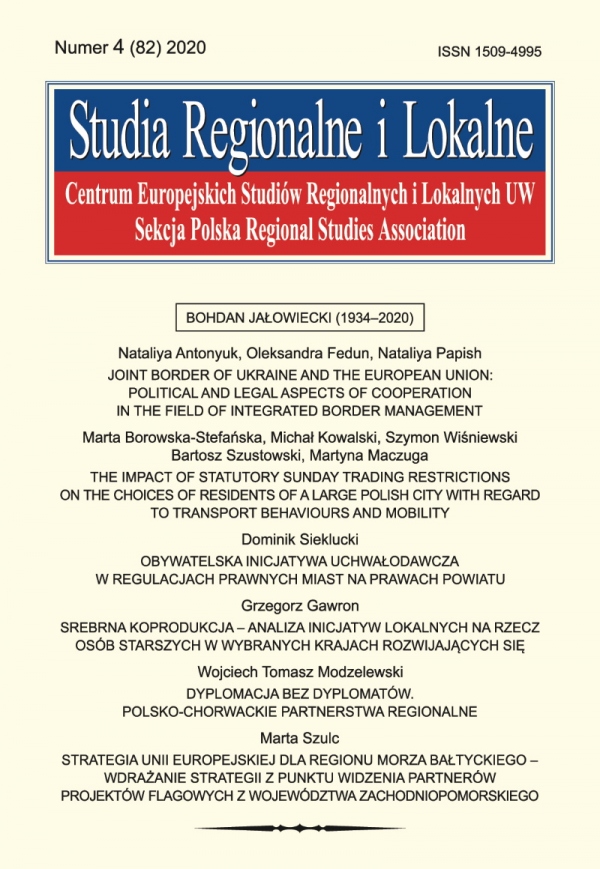
- Grzegorz GorzelakBohdan Jałowiecki (1934–2020)[more]
- Nataliya Antonyuk, Oleksandra Fedun, Nataliya PapishJoint Border of Ukraine and the European Union: Political and Legal Aspects of Cooperation in the Field of Integrated Border Management[more]
- Marta Borowska-Stefańska, Michał Kowalski, Szymon Wiśniewski, Bartosz Szustowski, Martyna MaczugaThe Impact of Statutory Sunday Trading Restrictions on the Choices of Residents of a Large Polish City with Regard to Transport Behaviours and Mobility[more]
- Dominik SiekluckiCivic Resolution Initiative in Legal Regulations of Cities with County Rights[more]
- Grzegorz GawronSilver Co-production – Analysis of Local Initiatives for the Elderly in Selected Developing Countries[more]
- Wojciech Tomasz ModzelewskiDiplomacy Without Diplomats. Polish-Croatian Regional Partnerships[more]
- Marta SzulcImplementation of the European Union Strategy for the Baltic Sea Region from the perspective of the Flagship Project Partners from the Western Pomerania Region (Zachodniopomorskie Voivodship)[more]
Grzegorz Gorzelak
Nataliya Antonyuk, Oleksandra Fedun, Nataliya Papish
The article discusses the political and legal aspects and the dynamics of Ukraine’s interaction with the EU and its Member States in the field of integrated border management in order to improve interagency and international cooperation, introduce joint control at checkpoints, organise joint patrols, improve the level of security and openness of state borders and enhance their integration function. The issues of construction and modernisation of checkpoints, implementation of European border standards, customs and other types of control at the state border of Ukraine and the EU countries have been researched. The perspectives of Ukraine’s entry into the integrated border management system at the present stage have been outlined. The mechanisms of in-depth cooperation in the field of integrated border management under conditions of implementing the Association Agreement between Ukraine and the EU have been elucidated.
Marta Borowska-Stefańska, Michał Kowalski, Szymon Wiśniewski, Bartosz Szustowski, Martyna Maczuga
The main purpose of the paper is to recognise the impact of statutory Sunday trading restrictions on consumer behaviours (shopping time) and mobility (activeness, motivation, modal division) of residents in Łódź, one of the largest Polish cities. An additional aim is to determine the independence of the indicated elements for selected features of the surveyed residents and their households, for which purpose a two-stage questionnaire survey was conducted among the residents/dwellers of Łódź. The first stage was performed during a week following a non-trading Sunday, and the respondents were asked to refer specifically to the previous Sunday. The second phase was carried out during a week immediately following a trading Sunday, with the questions focused on that particular Sunday. The returned results showed that the main factor determining the time when people do their shopping to make up for a non-trading Sunday is their professional Sunday activity. The answers also revealed that the residents of Łódź chose an inactive and rather a “couch-potato” lifestyle on the analysed Sundays, whether trading or non-trading.
Dominik Sieklucki
Ustawa z 11 stycznia 2018 roku o zmianie niektórych ustaw w celu zwiększenia udziału obywateli w procesie wybierania, funkcjonowania i kontrolowania niektórych organów publicznych (Dz.U. 2018 poz. 130) zobligowała wszystkie jednostki samorządu terytorialnego do wprowadzenia obywatelskiej inicjatywy uchwałodawczej oraz uregulowania w uchwale organu stanowiącego podstawowych procedur związanych z przygotowywaniem i składaniem wniosków. W artykule przedmiotem analizy są działania implementacyjne podjęte w miastach na prawach powiatu. Wskazano w nim, że przed wejściem w życie ustawy 55 miast z 66 wprowadziło już tę instytucję i w ich przypadku ustawa doprowadziła do ujednolicenia procedur. Ponadto stwierdzono, że część miast nie dokonała implementacji przed rozpoczęciem VIII kadencji samorządu, a w kilku wystąpiły problemy z implementacją, skutkujące brakiem możliwości wykonania inicjatywy uchwałodawczej przez obywateli. Artykuł przedstawia stan prawny na dzień 31 grudnia 2019 roku.
The Act of 11 January 2018 amending certain acts in order to increase participation of citizens in the process of selecting, functioning and controlling certain public bodies (Journal of Laws 2018, item 130) obliged all local government units to establish a citizens’ resolution initiative and to regulate the basic procedures related to the preparation and submission of applications by a resolution of their law-making body. The article analyses the implementation activities undertaken in cities with county rights. It indicates that before the entry into force of the Act, 55 cities out of 66 had already implemented such an arrangement, and, in their case, the Act helped unify the procedures. The article also points out that some cities did not implement these regulations before the beginning of the 8th term of office of local governments, and in several cases there were problems with the implementation, which prevented citizens from exercising their resolution initiative. The article presents the legal status as of 31 December 2019.
Grzegorz Gawron
Artykuł poświęcony jest idei koprodukcji rozumianej jako świadomy i celowy współudział obywateli w organizacji i świadczeniu usług publicznych. Zagadnienie to przedstawiono w kontekście procesu globalnego starzenia się jako zjawiska, które skutkuje koniecznością podejmowania działań służących zabezpieczeniu potrzeb rosnącej populacji osób starszych. Podstawę empirycznej części rozważań stanowiło badanie zrealizowane pod egidą jednej z agend Światowej Organizacji Zdrowia (WHO) – Centrum Rozwoju Zdrowia w Kobe. Obejmowało ono analizę studiów przypadków inicjatyw kierowanych do seniorów w lokalnych środowiskach dziesięciu wybranych krajów rozwijających się (Chile, Chiny, Iran, Liban, Rosja, Serbia, Sri Lanka, Tajlandia, Ukraina, Wietnam). Kluczowe kryterium wyboru analizowanych projektów stanowiło bezpośrednie zaangażowanie w ich realizację instytucjonalnych i pozainstytucjonalnych przedstawicieli społeczności lokalnych. Autor jako uczestnik (badacz) tego międzynarodowego przedsięwzięcia podjął próbę analizy możliwych do zaobserwowania przejawów senioralnej koprodukcji charakteryzujących poszczególne inicjatywy.
The article discusses the idea of co-production, understood as informed and intentional participation of citizens in the organisation and provision of public services in the context of the global ageing process, a phenomenon which necessitates actions aimed to secure the needs of older people. The basis for the empirical investigation was a study carried out under the aegis of a WHO agency, the Centre for Health Development in Kobe, Japan. It offers an analysis of the case studies of initiatives addressed to elderly people in the local communities of 10 selected developing countries (Chile, China, Iran, Libya, Russia, Serbia, Sri Lanka, Thailand, Ukraine, Vietnam). The key criterion in the selection of the analysed projects was direct involvement of institutional and non-institutional representatives of local communities in their implementation. As a participant (researcher) of this international survey, the author analyses the observable manifestations of silver co-production characterising the individual initiatives.
Wojciech Tomasz Modzelewski
Regiony podejmują aktywność międzynarodową określaną jako paradyplomacja. Jest ona podobna do dyplomacji państwa, podlega jego prawu oraz polityce, korzysta z podobnych narzędzi, np. protokołu dyplomatycznego, choć nie jest realizowana przez profesjonalnych dyplomatów. Paradyplomację regionów należy analizować jako źródło nowych stosunków międzynarodowych, a regiony postrzegać jako nowych uczestników życia międzynarodowego. W artykule przedstawiono paradyplomację polskich samorządów szczebla wojewódzkiego i regionów (żupanii) Chorwacji, a w charakterze studium przypadku współpracę województwa warmińsko-mazurskiego z żupanią splicko-dalmatyńską.
Regions can get involved in international-relations activity defined as paradiplomacy. It is similar to state diplomacy as it is subject to its law and policy and uses similar tools such as diplomatic protocol, but is not pursued by professional diplomats. Regional paradiplomacy needs to be analysed as a source of new international relationships. Consequently, regions should be perceived as new actors in international relations. The article focuses on the paradiplomacy of Polish regions (voivodships, or województwa) and Croatian counties (Hrvatske županije). The case study discusses the cooperation between the Warmińsko-Mazurskie Voivodship and the Split-Dalmatia County.
Marta Szulc
Strategia Unii Europejskiej dla regionu Morza Bałtyckiego jest wdrażana przez realizację projektów flagowych. W artykule przedstawiono wyniki badania przeprowadzonego z udziałem koordynatorów partnerów projektów flagowych realizowanych w województwie zachodniopomorskim. Sprawdzono w nim, czy projekty flagowe wspierają wykonywanie postanowień EUSBSR, czy przyczyniają się do podejmowania wyzwań stojących przed regionem Morza Bałtyckiego. Zbadano także poziom zaangażowania podmiotów realizujących projekty oraz interesariuszy tychże projektów. Badanie projektów flagowych miało na celu analizę mechanizmów wdrażania za ich pomocą EUSBSR oraz dopełnienie wyników ilościowych. W konkluzjach artykułu przedstawiono konkretne rezultaty oraz rekomendacje dla podmiotów mających wpływ na funkcjonowanie EUSBSR.
One of the elements of the implementation of the European Union Strategy for the Baltic Sea Region is completion of the flagship projects. The article presents the results of a study carried out with the participation of the coordinators of the flagship project partners in the Baltic Sea region. The study of the flagship projects was aimed at analysing the implementation of the EUSBSR through these projects and at complementing the quantitative results. As a result of the research, specific results and recommendations for actors affecting the operation of the EUSBSR are presented in the conclusions.